Showing posts with label prophecy. Show all posts

Nov 23, 2018

The Truth About Eternity (Revelation 21:1-4; pt 3)


(pt. 3)


INTRO: “How might I ascertain the church’s official view of heaven & hell?" To which one notable clergyman in the Church of England offered this pithy one word reply- "Die."  

Praise be to God that we do not have to wait until we "cross over the other side" to find out about heaven and hell.  Everything we need to know about the future has been preserved in the Word of God.  We do not need to read Charismatic books about alleged "out of body experiences" in order to shore up our understanding of the future.  In his grace, God has revealed everything we need to know about life and life after death  in the Bible (2 Timothy 3:15-17).  Any books, testimonies, or articles about heaven and hell need to be evaluated against the perfect backdrop of Scripture.

(Christian) how much do you know about your eternal home?  Is what you believe about heaven and hell truly biblical?  

Why does the apostle John include so many details about the eternal state when writing to the persecuted church in the first century (see Revelation 21:7)?  "Those who overcome (true believers) shall inherit all this!"  The sights and sounds of heaven should compel us to "keep on keeping on" in the strength of the Lord!


(Three) Heavenly Incentives for Christian Perseverance:

On 10/28, we saw:

1) In heaven, _______________________________________________________________.


(Revelation 21:1; 4)

Last Sunday, we saw and heard this:

    2) In heaven, _______________________________________________________________.

(Revelation 21:2-3; Psalm 16:8-11)


Richard Baxter- “Doubtless as God advances our senses and enlargens our capacity, so will He advance the happiness of those senses and fill up with Himself all that capacity…
We shall then have light without a candle, and perpetual day without the sun…”

Revelation 5:8-12, 22:14-17


How do the “sights and sounds of heaven” help us to lift our eyes off of our earthly struggles?


Next Sunday we will “see and hear” this:

3) In heaven, _______________________________________________________________.


(Revelation 21:4-5)

Holy Spirit help me to be a heavenly-minded Christian and help us to be a heavenly-minded congregation! Use these glorious truths about eternity to bolster our faith and to get each one of us across the “finish line! For the glory of Christ we ask these things. Amen!” 

Oct 12, 2018

7 Reasons Your Church Should Take Eschatology Seriously

Photo Credit: TGC
It is concerning that some churches today don’t take eschatology seriously. The very fact that God has revealed so many details about events to come in both testaments tells us that it is important. At the center of biblical eschatology is the blessed hope of the appearing of our great God and Savior, Jesus Christ (Titus 2:13). Not only should we be interested in prophetic events to come, we are also looking for our Savior, with whom we will spend eternity.

Why do some churches neglect serious study of eschatology? One issue is complexity. There are many eschatological details in the Bible to work through and harmonize. So there is hard work to do in this area. Also, when we see godly men disagreeing on prophetic issues, it can be disheartening. Another reason might be that some don’t want to be linked with those who have abused eschatology. There are those who have become obsessed with the end times by offering a date for Jesus’ return, or treating many current events as fulfillments of Bible prophecy. So some people have swung away from the abuse of eschatology to no interest at all.

But these are not good reasons to avoid the study of eschatology. Below are 7 reasons churches should take eschatology seriously:

1. ESCHATOLOGY IS A MAJOR PART OF THE CHRISTIAN STORYLINE

Eschatology is a major part of the Bible’s story. By “story,” I’m not talking about fiction. I’m talking about the narrative of the Christian worldview. Since Christianity is rooted in history and real historical events, God’s story includes past, present, and future events. All should be taught. We simply should not ignore prophetic events that are future from our standpoint—events such as the rapture, the Day of the Lord, the Second Coming, the Millennium, and the Eternal State. We must also talk about heaven and hell, and the coming New Earth. To avoid discussion of eschatology is to avoid an important part of the Christian worldview.

2. WE ARE CALLED TO PREACH AND HEED THE WHOLE COUNSEL OF GOD

There are large sections of Scripture devoted to prophecy, many of which still need to be fulfilled from our current standpoint. For example the events of Ezekiel 36–48 still need to occur. In the New Testament passages like Matthew 24-25; Mark 13; much of Luke 21; 1 Thess. 4-5; 2 Thess 1-2; 2 Peter 3; Revelation 6-22 describe events that still need to happen. We cannot ignore these passages. Paul says in Acts 20:27, “I did not shrink from declaring to you the whole purpose of God.” If your church does not teach what the Bible says about the future, the whole counsel of God is not being taught.

Oct 9, 2018

Is that You Lord? Hearing the True Voice of God

"Most believers think that God speaks to them on a regular basis. At least based on my experience, that appears to be the common perception. People use the expression “God told me” or “I heard God” all the time. Certainly, in its worst form, it announces the blasphemous declarations of today’s preachers of the prosperity gospel. Unfortunately, far too many people mimic that language in their everyday conversation. By using such language, they may be attempting to give legitimacy to a decision they’ve made or to defend some action they taken. For others, it may be an attempt to validate (or even to reach for) some level of perceived intimacy with God. They understand that intimacy is built on two-way communication, and so they feel a need to express their relationship to God in terms that capture the dynamic of dialogue, not monologue. But in all these cases, as teachers and leaders, we need to, first of all, help our people understand the theological dangers inherent in this kind of language. Second, we need to boldly present to people the power of God’s voice in its active sense through the Word of God.

For ages discerning pastors and theologians have recognized the dangers in claiming to hear the voice of God outside of Scripture. They recognize that there are stern warnings in Scripture against attributing to God words which, in fact, He did not speak (cf. Deut 18:20; cf. 13:1–5; 1 Cor 14:29–31). Because of the inherent authority that comes with a Word from God, the Lord recognized the potential abuse if people were to claim His authority for messages that merely come from their own imagination. For that reason, He not only established the very high standard of infallibility for all who claim to be His spokesmen, but He often confirmed them with accompanying miraculous signs (Acts 2:22; 5:12; 2 Cor 12:12). Therefore, for us to claim that God is speaking to us apart from Scripture potentially misrepresents God and places us in danger of His judgment. Instead, we recognize that divine revelation has come to us in the Holy Scripture (1 Cor 2:7–13; 2 Pet 1:19–21), and that this “canon” of Scripture was closed with the writing of the final book of the New Testament in the late first century (Rev 22:18–19). This has been the historic view of the church for most of its existence.

Sep 24, 2018

Last Things: The Final Judgement; Revelation 20:11-15 (pt. 1)


Even in Christian circles, hell is often viewed as a “four-letter” word. Why is this?

Emotional difficulties-

Intellectual objections-

Many in our day avoid Rev. 20:11-15 like the black plague. Why is this immensely problematic?

To help us wrap our hearts and minds around the Final Day of Judgment and in effort to make the Text-driven application more attainable-we’ll highlight 7 Key Statements over the next few weeks:


1) The ABSOLUTE NECESSITY of this Great and Final Judgment

(Revelation 20:7-15; John 3:19-20)

What God reveals in Revelation 20:7-9 helps us come to terms with verses 11-15. Unbelieving humanity would rise up in rebellion against Christ and the people of God over and over again.  Their would be no "heaven" if God did not judge the world once and for all (study Revelation 20:11-15 in view of what comes before it- the Horrific Tribulation period, Rev. 6-18, and the Final Rebellion of Satan and Hell-bent Humanity, Rev. 20:7-9).


2) The PERFECT CHARACTER of this Great and Final Judgment

(Revelation 20:11; Hab. 1:13; Psalm 1:5-6;)


How should we respond to the biblical truth that’s been preached this AM?  Now what?

For Further Reflection/Application:  We must be doers of the Word and not merely hearers

Why is it “emotionally” difficult for sinful man (even redeemed sinners) to embrace the reality of a final Judgement Day?  Romans 2:5; John 3:36; Hebrews 9:27, Luke 16:19-31.

John the Baptist’s message was bold and direct yet it was also powerful and saving. 
Read Matthew 3:1-11.   Ask God to give you holy boldness like John the Baptist.

Sep 4, 2018


Future Things: The Way Things Ought to Be


INTRO:  “The Way Things Ought to Be” -VS- the way things often are.


What about the Future Kingdom of Christ so energizes, strengthens, encourages, and mobilizes true believers?

The prophesied future is intended to impact the here and now!  


5 characteristics define the future Millennial Kingdom

As we take a jet tour overview of Isaiah keep track whenever you hear about:

1) Liberty and Justice for All


2) Peace in the Middle East (and beyond)


3) “Universal Healthcare”


4) “Eden-like” Conditions


5) Salvation Near and Far!


For Further Reflection/Application:  We must be doers of the Word and not merely hearers

What aspects of the “curse” have impacted your personal life the most?  List 2-3 things.

When life is too good why is it so tempting/easy to lose sight of “the age to come?” 
God commands believers to live each day in light of eternity (Col. 3:1-4)

How does God use trials in our life to make us more faithful believers? 
Note Romans 5:1-5; James 1:2-4; 2 Cor. 4:16-18

How does biblical prophecy help us get through the darkest valleys of life? 


Related Praise Songs:  Theology fuels Doxology!  We dig deeply in order that we may go high!

Joy to the World-
Crown Him With Many Crowns!
The Hallelujah Chorus-
Jesus Shall Reign- Keith and Kristyn Getty

Aug 30, 2018

Future Things: The Devil’s Disastrous End- Revelation 20:1-3


Future Things: The Devil’s Disastrous End


INTRO:  Parallels between the Iraq War and Revelation 19-20:

 A)     Shock and Awe-                                              (Rev. 19:11-18)

B)     Two-thirds of the Terrible 3 Taken Out -       (Rev. 19:19-21)

C)    Unfinished Business-  (Saddam)                       (Rev. 20:1-3)


In order to help us better understand this prophetic portion of Scripture we’ll hang our thoughts on three words:


1) Sequence 
(Rev. 20:1a; 19:17, 19; 20:4, 11).

The key chronological phrase that is used in Revelation- "Then I saw."


2) Subjugation 

(Rev. 20:1b-3)

Satan is summarily rounded up, bound, and thrown into the Abyss. He will not be free to prowl about like a roaring lion and will not be able to deceive the nations during the future earthly Kingdom.


3) Suprise 

(Rev. 20:3b)

Satan MUST be released for a short while after the Millennial kingdom...


For Further Reflection/Application:  We must be doers of the Word and not merely hearers

What are some of the names and/or biblical descriptions in Scripture related to our archenemy (Satan)?  What do these names suggest concerning the on-going Devilish activity of the Evil One?  (Genesis 3; Job 1; Matt. 4:1, 3; 13:19; John 8:44-45; Eph. 2:2; 2 Cor. 4:4, 6:5 1 Peter 5:8; Rev.12:9-10, 20:1-3, 10).

What are some of the sinister schemes of Satan against believers and against the Church?  Satan wants to divide us.  Satan wants to deceive us.  Satan wants to unite us (around anything but the Word of truth and Christ).  Satan wants to distract us.  Satan wants to tempt us.  Satan wants to condemn us in hopes of immobilizing us.  What else?  What do you say happening in your own life and/or in your own congregation? 

Aug 28, 2018

Futuristic Premillennialism: Why There Must Be a Future Earthly Kingdom of Christ

We believe the Bible teaches that there must be a future, earthly, Messianic Kingdom and that this long-anticipated kingdom will last 1000 years (see Revelation 19-20).  

Our doctrinal convictions related to the end times do not rest on a single text of Scripture; (though Revelation 20 is abundantly clear).

The Biblical Case for Futuristic Premillennialism is supported by Seven Lines of Reason:


It's 1) the Fruit of a Consistent “Hermeneutic.”

“Hermeneutics” is 'the study of the principles and methods of interpreting the text of the Bible as to ascertain the original intent of the Divine/human authors of Scripture.'
  
Note our recent exposition of 2 Timothy 2:15 and a very important message on the "3 Key Words of Biblical Prophesy." 

All sermons can be downloaded for free on our website at www.lakecountrybible.org 


2) The Unconditional Promises in the Biblical Covenants.

See LCBC sermon series on Genesis 12 & 15 and our series on 2 Samuel 7 and Luke 1.


3) The Hope of the Old Testament Saints and Prophets.

Per my exposition of Hosea 3.  Note key prophetic passages such as Isaiah 11, Daniel 9, and Zech. 12-14.  

Aug 25, 2018

Matthew 25:31-46; The Great Separation


(pt. 12)

Many believers hold different interpretations when it comes to the finer point of biblical eschatology (truth related to the end times). What should we do when good and godly saints disagree over some point of doctrine? What should we not do?  

Here is a summary of the Last Days According to Jesus.  The Master-Teacher taught his disciples Four Key Truths:

1) When the Messianic King Comes He Will Establish the Long-Awaited Kingdom-just not right away!  (Luke 19:11-27)

2)  For Rejecting her King, the Jewish People will be repeatedly trampled upon UNTIL “the time of the Gentiles is complete.” (Luke 19:28-44; 21:24)

3) The Glorious Kingdom will begin WHEN national Israel finally welcomes Jesus as Savior, Lord, and King!   (Luke 13:34-35)

4) Upon Reestablishing the Throne of David, the Son of Man will Judge the (Unbelieving) Nations! (Matthew 25:31-46)

Matthew 25:31-46 (the sheep and goats judgement) is different than the final judgement in Revelation 20:11-15.  The first takes place before the Millennial Kingdom and the second takes place after the Messianic Kingdom.  Some Christian theologians teach that Matthew 25 and Revelation 20 are talking about the same event.  On textual grounds we lovingly disagree.  And here's why:

Matthew 25:31-46 

A)   Unlike Rev. 20, the judgment here involves BOTH sheep & goats!

B) Unlike Rev. 20, those judged in Mattthew 25 are ALIVE (when King Jesus Returns to earth)

C) Unlike Rev. 20, this judgement takes place on EARTH BEFORE the Millennial Kingdom!

The key words in v. 31 are WHEN and THEN.

D) Unlike Rev. 20 the judgement in Matthew 25 is specifically related to the mistreatment of Tribulation saints!

Humanitarian groups often quote Matthew 25:34-46 out of context.  We must always study and apply the Bible in context.  Failure to do so leads to various errors (some more significant than others).


For Further Reflection/Application:  We must be doers of the Word and not merely hearers

Aug 23, 2018

Find a Church that Teaches ALL of the Bible (Including the End Times)

Having spent many weeks considering one of the great end times passages of Scripture (Matthew 24-25)- let's talk a bit more about practical application: How should the prophesied future impact the here and now? What are some of the main take aways of this study? Why should we love this biblical genre?

We quickly discovered that the disciples' were confused about certain key details related to the Kingdom of God (note Mt 24:3). If Jesus is the Messianic King, why does it seem as if the long awaited Kingdom is not going to launch right away; (note the larger context in Matthew 23:37-39)?  Just like 2000 years ago, many believers today are also dazed and confused when it comes to biblical eschatology; (Unlike the disciples in Matthew 24 we have the complete Old AND New Testament Scriptures).  Everything we need to know about the future has been preserved in the Word of God.  That's a really amazing reality!  It's our job to know what the Bible has to say about future things.  More on that point in a moment.

Jesus' longest recorded answer to any question in Scripture begins in Mt. 24:4 and ends approximately 100 verses later.  This simple textual observation alone tells us something of the importance of this subject.  The Olivet Discourse is about one main thing: the prophesied future.  If the details were important to Jesus they should interest us.

In today's evangelical world we need to be reminded that ALL the details/chapters of Scripture matter...this certainly includes details related to prophecy and eschatology. Over 25% of the Bible (8352 verses) fits into this genre... and yet so many believers know so very little of how these verses/events all fit together. Pan-millennialism has become the accepted norm- "I don't know or really care about many of the biblical details related to the end times- it's too confusing...But that's ok, because it'll all PAN out in the end." "Let's move onto a subject that's more important or relevant." Matthew 24-25 should correct such errant thinking that plagues the American Church today. Note also 2 Tim. 2:15, 3:16-4:5, and 2 Peter 3:16.

Aug 20, 2018

How the End of the Story Impacts Today and Tomorrow


Matthew 24:45-51

“If I had only known this or that I would have done things differently!”

When’s the last time you said this?   When is the last time you said this with regards to Scripture? For example, if I had known God's Word said this, I would not have done that.


General Outline of Jesus’ Olivet Discourse:

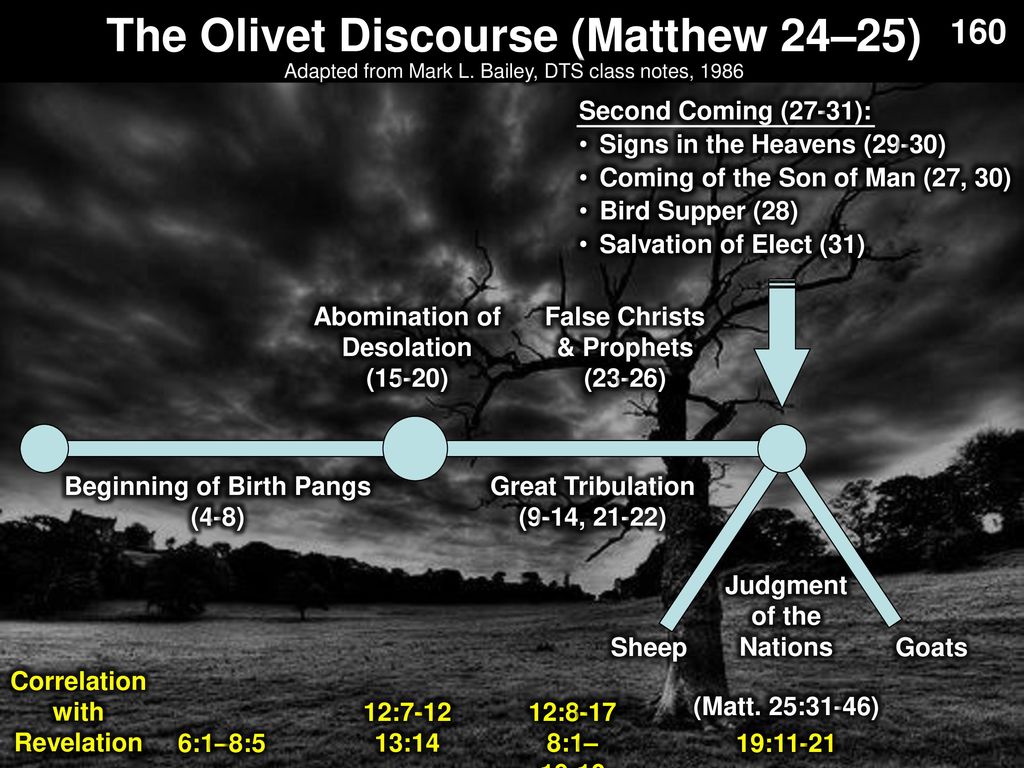
I) The Horrific Tribulation (Matthew 24:4-28)
II) The Glorious 2nd Coming (Matthew 24:29-32)


In view of the prophesied future (per v. 4-31) Jesus’ disciples must be:

1) Well versed students of Scripture (especially biblical prophecy).

(Matthew 24:32-35)


2) Ready and prepared for the end.

(Matthew 24:36-44)


While still remaining 3) Faithful stewards of the present

(Matthew 24:45-51)


Biblical stewardship can be defined as: Utilizing and managing all the resources God provides for the glory of Christ and for the spiritual good of others.  Think about the stewardship of time (Ephesians 5:16), money (Prov. 3:9), spiritual gifts (Rom. 12:6; 1 Pet. 4:10-11), God-given talents (Luke 12:48), family, intellect, etc. Note Matt. 24:45-47; 25:14f.  Are you a faithful and wise steward?


For Further Reflection/Application: We must be doers of the Word and not merely hearers

List the last 3-4 times you said to yourself, “If I had only known this or that I would have done things differently?” Provide at least two examples that are spiritual in nature and related to Scriptural revelation.

List two practical ways how the “end of the story” ought to impact today and tomorrow more fully in your own life? Read 1 Timothy 4:7-8 which talks about physical exercise and the spiritual disciplines in view of eternity. Elders/Pastors note 1 Peter 5:4.

Aug 14, 2018

Eschatology 101– Simple Definitions

We have been studying major prophetic passages in the Old and New Testament for over a year at Lake Country Bible Church.  Currently we are in Matthew 24-25 which is one of Jesus' clearest statements regarding the "end times."  For any of my Christian readers who think that eschatology is not very practical and relevant I'd encourage you to listen to this sermon titled, "How the End of the Story Impacts Today and Tomorrow."  The Holy Spirit has been showing me in my personal studies how often the future is used in relationship to the present.

The following article by Pastor Jesse Johnson is a nice summary as one seeks to understand basic definitions of key terms.  These simple definitions will help one make sense of the different major views on eschatology within the Christian church.  All believers embrace the core doctrine concerning the second Coming of Christ!  We all know and believe in the glorious return of Christ.  As with many doctrines, the more one studies the totality of the Scriptural revelation the less complicated this subject becomes.  At LCBC we are committed premillennialists.

"Eschatology: the study of future prophesied events associated with the Second Coming of Jesus, the kingdom, and eternity. Literally it is the study of the “end times,” but much of the study focuses on the rapture and the tribulation, two events that happen at least 1,000 years before the “end times.” Hence, my definition is better than the dictionary’s.

Millennium: A 1,000 year period where Jesus reigns over the earth. This period sees the restoration of Israel, and the fulfillment of the promises and prophecies given to Israel in the OT. Satan is bound, and the earth is inhabited by both resurrected believers as well as people who were born during the kingdom. It is described all over the book of Isaiah, but especially in Isa 24, 51, 54, 60, 65-66. It is also detailed in Ezekiel 37-48, Daniel 7, Zechariah 8, and Revelation 19-20.

Second Coming: A term that refers to the events that take place around the return of Jesus to earth. These events include the rapture, the tribulation, the anti-Christ, the abomination described in Daniel 9 and 2 Thesselonians 2, and the physical return of Jesus to earth.

Post-millennialism: The belief that the Second Coming occurs after the millennium. This is held by Douglas Wilson, R. C. Sproul, and Tim Keller.

Pre-millennialism: The belief that the Second Coming occurs before the millennium. This is held by John MacArthur, John Piper, D. A. Carson, and Wayne Grudem.

Amillennialism: The belief that that millennium is not an actual time period, but rather that scripture’s descriptions of that time period should be interpreted as being fulfilled in this age, and often spiritually. In other words, there is no millennium, and the kingdom of God on earth is now. This view is held by Michael Horton (and almost every Presbyterian you have ever met), Mark Dever, and J. I. Packer.

Aug 1, 2018

How the Future Impacts the Present


INTRO:  How does the disciples’ unpreparedness at Gethsemane tie in with this morning’s sermon text (note Matthew 24:36-44)?

If Jesus' faithful disciples were unprepared after a mere 60 minutes (see Matthew 26:40), how many believers will be caught asleep at the wheel when the King returns (2000+ years later)?  


How should the future impact the present?  Why is biblical eschatology so important?

How many believers today will be unprepared when the King finally returns after 2000+ years?  List 5 reasons why this is so. 

“I want to be more expectant and excited about the 2nd Coming of Christ but I am struggling to do so.”  How does one foster greater longings for future and eternal things?  Talk with another LCBCer who is “on fire” for Christ.


General Outline of Jesus’ Oliviet Discourse

I) The Horrific Tribulation                              (Matthew 24:4-28)

II) The Glorious 2nd Coming                            (Matthew 24:29-32)
 
                     (or)

I) End Times (Kingdom) Confusion                (Matthew 24:3)

II) Red Letter Clarification                             (Matthew 24:4-25:46)


The “Horrific Tribulation” and the “Glorious Return of Christ” should impact our lives in a multiplicity of ways.  In view of the prophesied future (per v. 4-31)- 

Jesus’ disciples must be:


1) Well Versed Students of Scripture (especially of biblical prophecy).

(Matthew 24:32-35)

Jesus’ disciples must be:

Jul 27, 2018

Future Things: The Glorious 2nd Coming. Matthew 24:29-35


INTRO:  As you think about the future, what do you look forward to the most? note Titus 2:13


I) The Horrific Tribulation 
(Matthew 24:4-28)

After the Tribulation Period (note Matthew 24:29f) comes
II) The Glorious 2nd Advent of Christ                     
(Matthew 24:29f)
 

The “Horrific Tribulation” and the “Glorious Return of Christ” should impact our lives in a multiplicity of ways:

Jesus’ disciples must be:  1) Well Versed Students of Scripture (and of Biblical Prophecy)
(Matthew 24:32-35)

Notice the first two commands of Christ in verses 32-33: "LEARN and RECOGNIZE!"


Tribulation showers (vv. 3-28) bring what? _____  Millennial Kingdom flowers!


What is “the pain then glory” principle.  (Rom. 8:16-18; 2 Cor. 4:16-18)

Think about this principle in view of the life of Job, Joseph, the Lord Jesus, and Israel's national history from AD 70 up through the future tribulation period. 

Jul 20, 2018

Matthew 24:15-28: The Horrific Tribulation. Study Guide For Comprehension and Application

 Revelation 20:1-6 and Matthew 24:15-28 
Future Things: The Horrific Tribulation
(pt. 8)

INTRO:  What do you wish you could know about your immediate future?


In the Master-teacher’s “Olivet Discourse” the Good Shepherd let’s his beloved sheep know:

A) What to expect? 
B) What signs to look for? 
& C) What they/we ought to do with this head full of knowledge?


This morning we’ll zero in on what Jesus' disciples ought to do” in view of the revealed truth that is Matthew 24:15-28   


1) UNDERSTAND THE PROPHETIC SIGNS 

(Matthew 24:15; Daniel 9-11; Rev. 11:2; 13)


2) RUN FOR YOUR LIVES  
(Matthew 24:16-19)


3) PRAY FOR PROVIDENTIAL MERCIES 
(Matthew 24:20-22; Genesis 6 Psalm 67; Isaiah 64)


4) EXERCISE BIBLICAL DISCERNMENT
(Matthew 24:23-28; 1 Thess. 5:21-22; 1 Chron. 12:32)


For Further Reflection/Application:  We must be doers of the Word and not merely hearers

What do you wish you could know as it relates to your immediate future?

Why do so many unbelievers live for the moment?  Many secular songs promote this mindset.

Jul 18, 2018

Matthew 24:3-14: Signs that the End is Near

Matthew 24:3-14

(pt. 7)

  
INTRO:  End Times Confusion and/or Indifference to Biblical Prophecy is commonplace.


LCBC believes that end times details that are recorded in the Scriptures matter: Explain why-____________________________________________________________________________ _______


Summarize Matthew 24-25 in a sentence or two: _____________________________________
____________________________________________________________________________
____________________________________________________________________________.


How should an unbeliever respond to facts of history (1 Cor. 15:1-11) and the details that God has revealed concerning things to come? (Acts 17:30-31; Hebrews 9:27-28; Romans 2:3-11). When you talk with lost friends, family members, and co-workers about what you’re being taught at church, help them to understand the practical ramifications of God’s revealed truth.


The Olivet Discourse: (Overview Outline)

A) End Times Confusion
(Mathew 24:3)


B) Red-Letter Clarification
(Matthew 24:4-25:46)