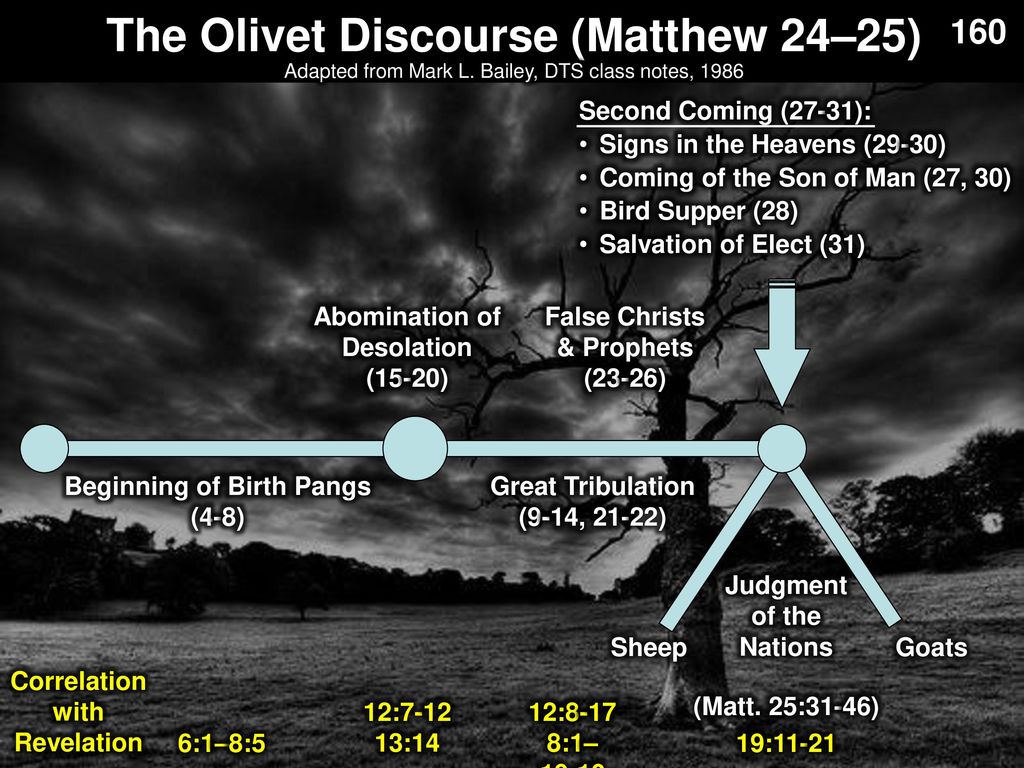
We have been studying major prophetic passages in the Old and New Testament for over a year at Lake Country Bible Church. Currently we are in Matthew 24-25 which is one of Jesus' clearest statements regarding the "end times." For any of my Christian readers who think that eschatology is not very practical and relevant I'd encourage you to listen to
this sermon titled, "How the End of the Story Impacts Today and Tomorrow." The Holy Spirit has been showing me in my personal studies how often the future is used in relationship to the present.
The following article by Pastor Jesse Johnson is a nice summary as one seeks to understand basic definitions of key terms. These simple definitions will help one make sense of the different major views on eschatology within the Christian church. All believers embrace the core doctrine concerning the second Coming of Christ! We all know and believe in the glorious return of Christ. As with many doctrines, the more one studies the totality of the Scriptural revelation the less complicated this subject becomes. At LCBC we are committed premillennialists.
"Eschatology: the study of future prophesied events associated with the Second Coming of Jesus, the kingdom, and eternity. Literally it is the study of the “end times,” but much of the study focuses on the rapture and the tribulation, two events that happen at least 1,000 years before the “end times.” Hence, my definition is better than the dictionary’s.
Millennium: A 1,000 year period where Jesus reigns over the earth. This period sees the restoration of Israel, and the fulfillment of the promises and prophecies given to Israel in the OT. Satan is bound, and the earth is inhabited by both resurrected believers as well as people who were born during the kingdom. It is described all over the book of Isaiah, but especially in Isa 24, 51, 54, 60, 65-66. It is also detailed in Ezekiel 37-48, Daniel 7, Zechariah 8, and Revelation 19-20.
Second Coming: A term that refers to the events that take place around the return of Jesus to earth. These events include the rapture, the tribulation, the anti-Christ, the abomination described in Daniel 9 and 2 Thesselonians 2, and the physical return of Jesus to earth.
Post-millennialism: The belief that the Second Coming occurs after the millennium. This is held by Douglas Wilson, R. C. Sproul, and Tim Keller.
Pre-millennialism: The belief that the Second Coming occurs before the millennium. This is held by John MacArthur, John Piper, D. A. Carson, and Wayne Grudem.
Amillennialism: The belief that that millennium is not an actual time period, but rather that scripture’s descriptions of that time period should be interpreted as being fulfilled in this age, and often spiritually. In other words, there is no millennium, and the kingdom of God on earth is now. This view is held by Michael Horton (and almost every Presbyterian you have ever met), Mark Dever, and J. I. Packer.